Chapter 1
Gunther Plüschow
Munich 1886 — Brazo Rico 1931. Naval aviator, Patagonian pioneer, author.
Gunther Plüschow was first an imperial naval cadet, then an officer, then an aviator. He was a prisoner, then an escapee, then an explorer and adventurer. In that order.
He fled China for America, crossed the United States, boarded a ship and became England's prisoner. In 1915 he escaped as the only German prisoner of war to make it back to Germany from Britain. An episode he later shaped into a bestseller that sold over 700,000 copies.
But what is remembered today is not the Donington Hall chapters. It is the journey from which he did not return.
From Tsingtau across the World
Plüschow was born on 8 February 1886 in Munich, into a family with Mecklenburg high nobility in the wider lineage — his grandfather was an illegitimate son of a Grand Duke of Mecklenburg-Schwerin. His father Eduard worked as a journalist; his uncle Wilhelm Plüschow ran a photographic studio in Italy that would later achieve international renown under the name Guglielmo Plüschow.
In 1914, Gunther Plüschow was stationed as a naval aviator in the German leasehold of Tsingtau (today Qingdao) when the First World War broke out and Japanese forces besieged the city. He flew a Rumpler Taube for days over the besieged territory — the only German pilot in Asia — until, shortly before the capitulation in 1914, he escaped to China. Via Shanghai he reached San Francisco, was arrested at Gibraltar, and arrived at the English internment camp Donington Hall. From there he escaped: across the Thames, across the North Sea, smuggled aboard a Dutch freighter. Back in Berlin in 1915.
A man who smuggles himself out of Donington Hall and onto a Dutch freighter is not deterred by Patagonian ice.
— Observation of the Manufactory, biographical note on Plüschow
The Turn Southward
By 1925 the war was over, the Empire too, and Plüschow was in his mid-forties. He read Robert Falcon Scott, Roald Amundsen. He recalled a picture of Tierra del Fuego he had pinned inside his locker as a cadet. He wanted to go to Patagonia. He wanted to reach "his Feuerland". First he sailed aboard the Parma, a large sailing vessel of the long-established Hamburg shipping company F. Laeisz. Then he acquired a ship of his own: the Feuerland, built in 1927 in Büsum to Plüschow's specifications — oak planking, generously dimensioned, built for ice. She put to sea in November 1927.
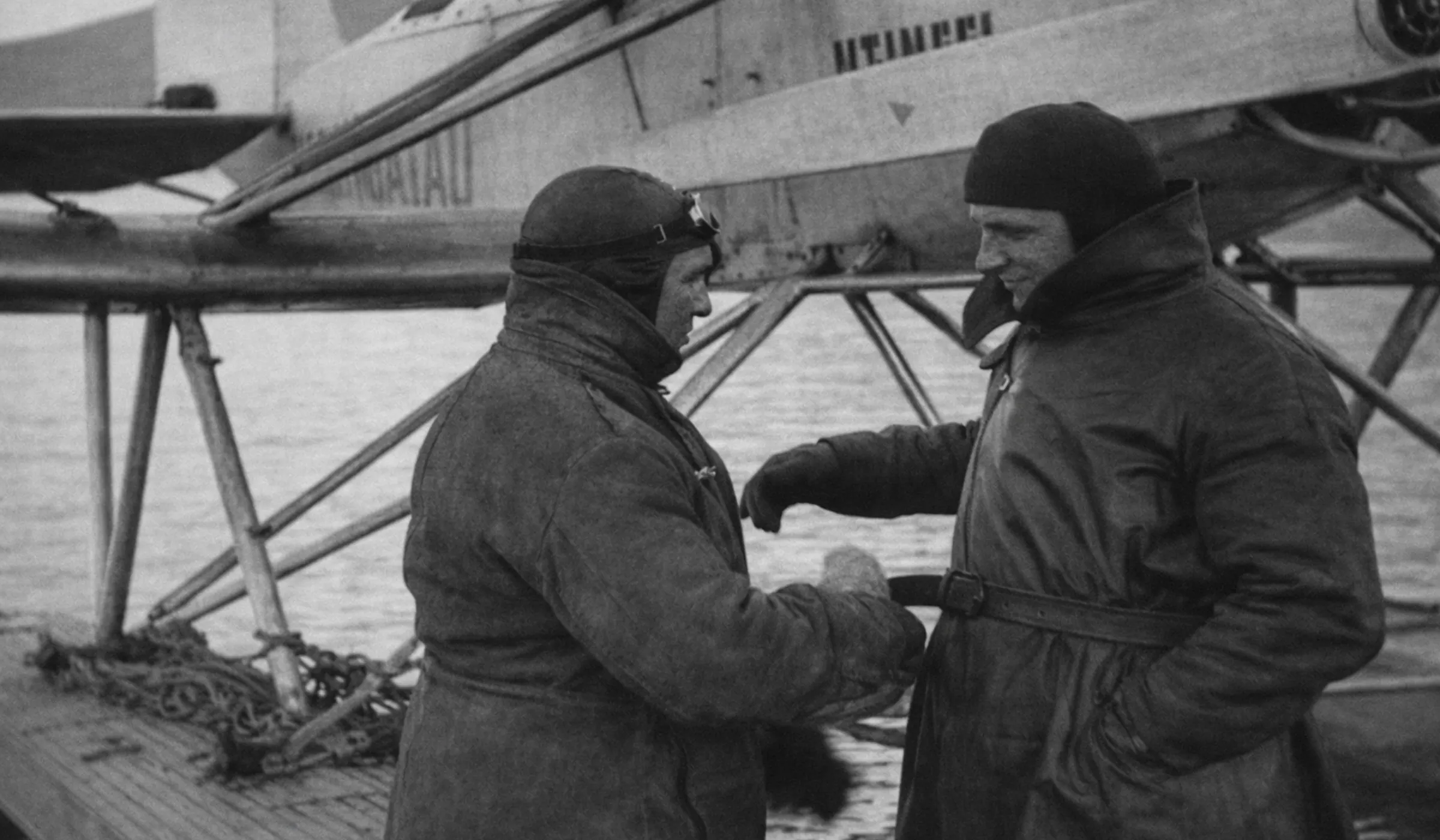
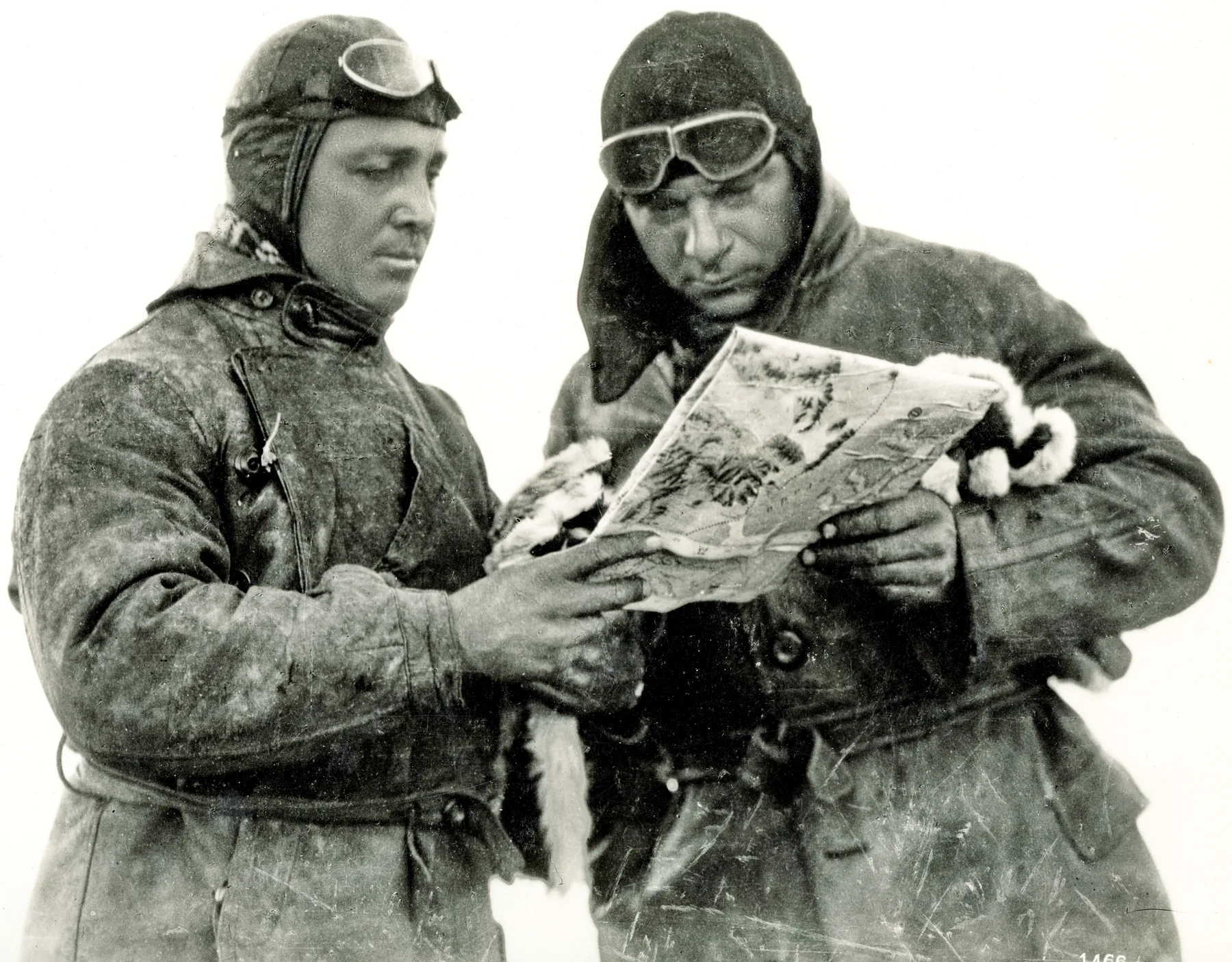
In 1928 the Feuerland reached Punta Arenas on the Strait of Magellan. There Plüschow and his flight engineer Ernst Dreblow assembled a seaplane that had been built in Warnemünde by the Heinkel works: the HD 24 W, registration "Tsingtau D 1313". Plüschow called it the Silberkondor. With it he flew over the Patagonian ice cap three times and filmed what no human being had ever seen from the air before.
The Final Flight
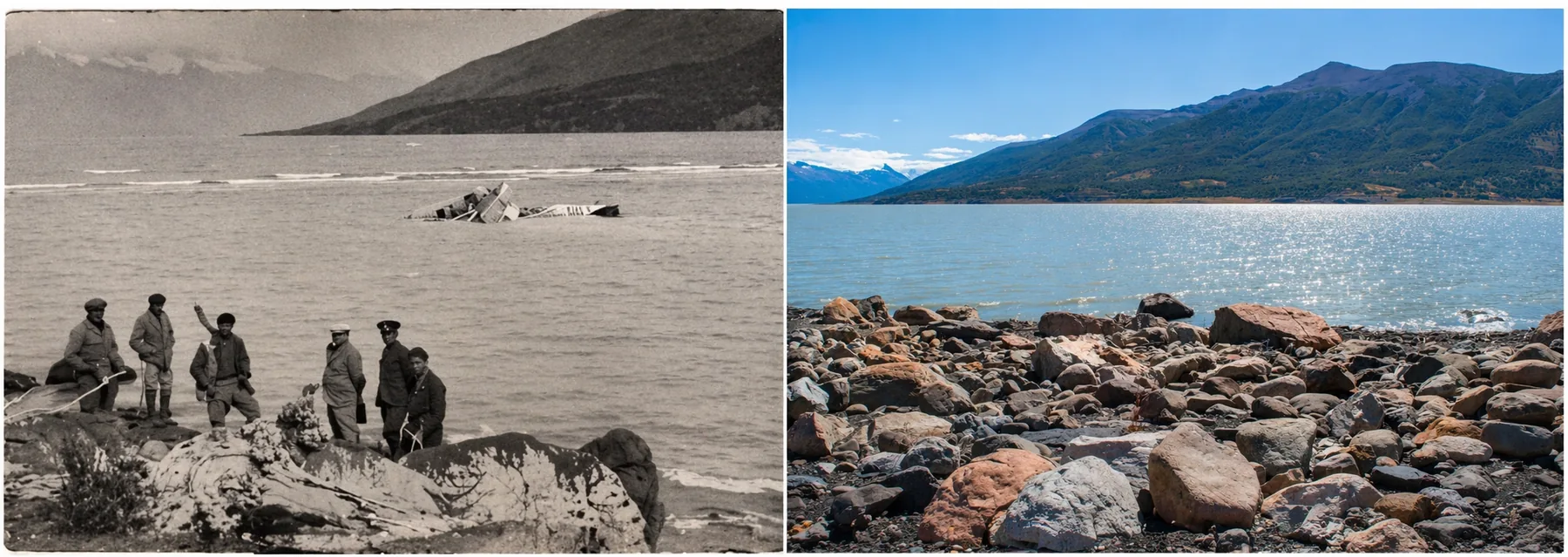
On 28 January 1931, barely three hours after taking off from Lake Argentino, the Silberkondor crashed on a shore of Brazo Rico — a lateral arm near the Perito Moreno Glacier. Plüschow and Dreblow were recovered dead. Their mortal remains were transferred to Germany. Thousands of people accompanied the funeral procession to their burial in Berlin.
Plüschow left behind a son, Guntolf, born in 1918, and a widow, Isot Plüschow. His body of work — three books, one documentary film, several thousand metres of film footage — fell at first into the customary obscurity of the interwar years. Only decades later, through the efforts of the Berlin-based Friends of Gunther Plüschow Association (Förderkreis Gunther Plüschow e.V.) under Gerhard H. Ehlers and its co-administration in Buenos Aires, did the memory return.
Plüschow and the Manufactory
What is the timber from his ship doing in a northern German manufactory? Plüschow himself would most likely have given a pragmatic answer: a ship built to endure can, after 98 years, also become the handle of a knife that will endure.
The Moorschmied Manufactory has a biographical connection to Plüschow that is no coincidence. Wolf-Dieter Schröppe, the senior of today's Moorschmied Manufactory, was born in Buenos Aires and is himself a devoted traveller to Patagonia. His father Benhorst Schröppe had already given a Patagonia slide lecture in Argentina in the 1970s, with Plüschow as his point of reference. His father was also present at the handover of the first commemorative plaque — prepared by a singing circle under Lothar Herold — to the youth group of the Nerother Wandervogel (German youth movement, founded 1921), which in 1962 built the first memorial near the site of Plüschow's crash. More on this on the Three Generations page.