Chapter 3
Germany, Patagonia
Three expeditions, 1927–1931. First aerial footage from the Patagonian inland ice. Plüschow's final flight at Brazo Rico.
Between 1927 and 1931, Plüschow undertook three voyages to Tierra del Fuego. The first was a reconnaissance. The second a systematic film expedition. The third he did not survive. What he brought back from these journeys — photographs, reels of film, diaries, charts — remains to this day the core of what German-language Patagonian research knows of the inner ice-landscape region between Lake Viedma and Cape Horn. This includes the first aerial photographs from the Argentine Fitz Roy region, the Chilean Paine region, and the inland ice as far as the glaciers and fjords of Tierra del Fuego, above the southernmost city of Ushuaia and, finally, Cape Horn.
The Route
On 27 November 1927 the Feuerland left Büsum. Plüschow sailed south across the Atlantic, putting in at Bahia, Rio de Janeiro and Buenos Aires. In each of these cities he met German settlers, raised funds and called on authorities. Buenos Aires was home at that time to a growing German diaspora — a fact that would later acquire its own significance for the Manufactory.
On 23 October 1928 the Feuerland reached Punta Arenas on the Strait of Magellan. Here the sailing leg of the expedition ended. The Feuerland now served as base camp for the flights with the Silberkondor. The film work began.
The Silberkondor Takes to the Air
In Punta Arenas, Plüschow and Dreblow assembled a seaplane that had been built in Warnemünde by the Heinkel aircraft works: the HD 24 W, single-engine, fitted with aluminium floats. Plüschow called her the Silberkondor (Silver Condor). In December 1928 the reconnaissance flights over the Cordillera Darwin and the inland ice began.
The conditions were exceptional. The inland ice lies between 0 and 1,500 metres in altitude, winds can accelerate to 100 knots, and the cloud ceiling often closes in within minutes. Plüschow flew without radio, without modern navigation, by compass and by sight. The film camera was mounted on the side of the aircraft, and co-pilot Ernst Dreblow filmed with a hand-held camera at considerable risk. The footage captured ranks among the earliest moving images from this land of ice.
Three voyages, two films — and a story that would have been unthinkable without this ship.
Three voyages, two films
Gunther Plüschow undertook his first South American expedition in 1925 aboard the four-masted barque Parma. After rounding Cape Horn he disembarked at the Chilean port of Valdivia. From there he continued by land and sea through Chile, where in the Paine massif he formed a friendship with the Lauezzari family, the managers of Estancia Cerro Guido. He promised them he would return and fly over the unconquered peaks.
The journey continued through Peru and Ecuador. After his return he published his book Segelfahrt ins Wunderland in 1926. The first film he shot during this expedition is to this day considered lost.
With this groundwork laid — a thorough engagement with the subject and a search for sponsors — he now embarked on his second expedition. It began on 27 November 1927 in Büsum aboard his ship Feuerland, and was extended by the addition of his aircraft Silberkondor. From photographic, film and written material came the documentary film Silberkondor über Feuerland, which ran in German cinemas in 1929, as well as the book of the same title, published by Ullstein Verlag.
Plüschow had sold the ship at the start of 1929 to finance the return voyage. For the third expedition he did not purchase a new vessel; instead he travelled by passenger liner, arranged logistics locally, and reassembled the Silberkondor, which had been stored in crates at the Frigorífico Bories (cold storage plant) in Puerto Natales, Chile.
Brazo Rico, 28 January 1931
His final flight routes took him over Lake Argentino and Lake Viedma. On one of these flights the biplane was hurled into a mountain lake — a "hell's cauldron". "It was almost a crash." Two days later, on 28 January 1931, at ten o'clock in the morning, he wrote in his diary: "We must take off now! I want to fly straight through to Camp 2 on Lake Argentino. I want out of here."
The take-off succeeded. Barely three hours later, shepherds on a farm on the Brazo Rico — a southern arm of Lake Argentino — watched as the aircraft plunged from approximately 300 metres. The machine came down rolling sideways. Both occupants died. A makeshift grave was erected on the spot. Within days the mortal remains were transferred via Buenos Aires to Germany. The funeral service was held in Berlin.
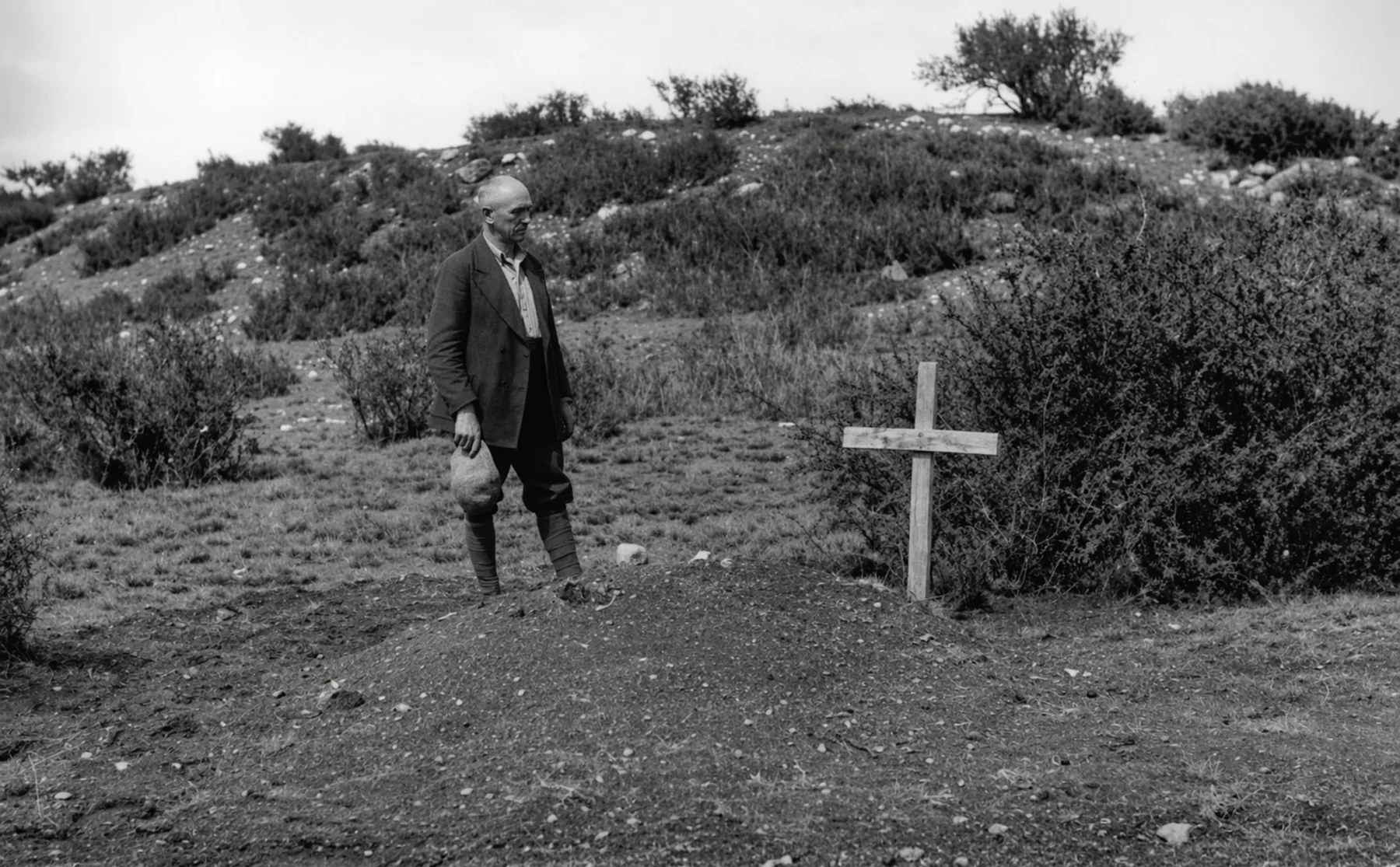
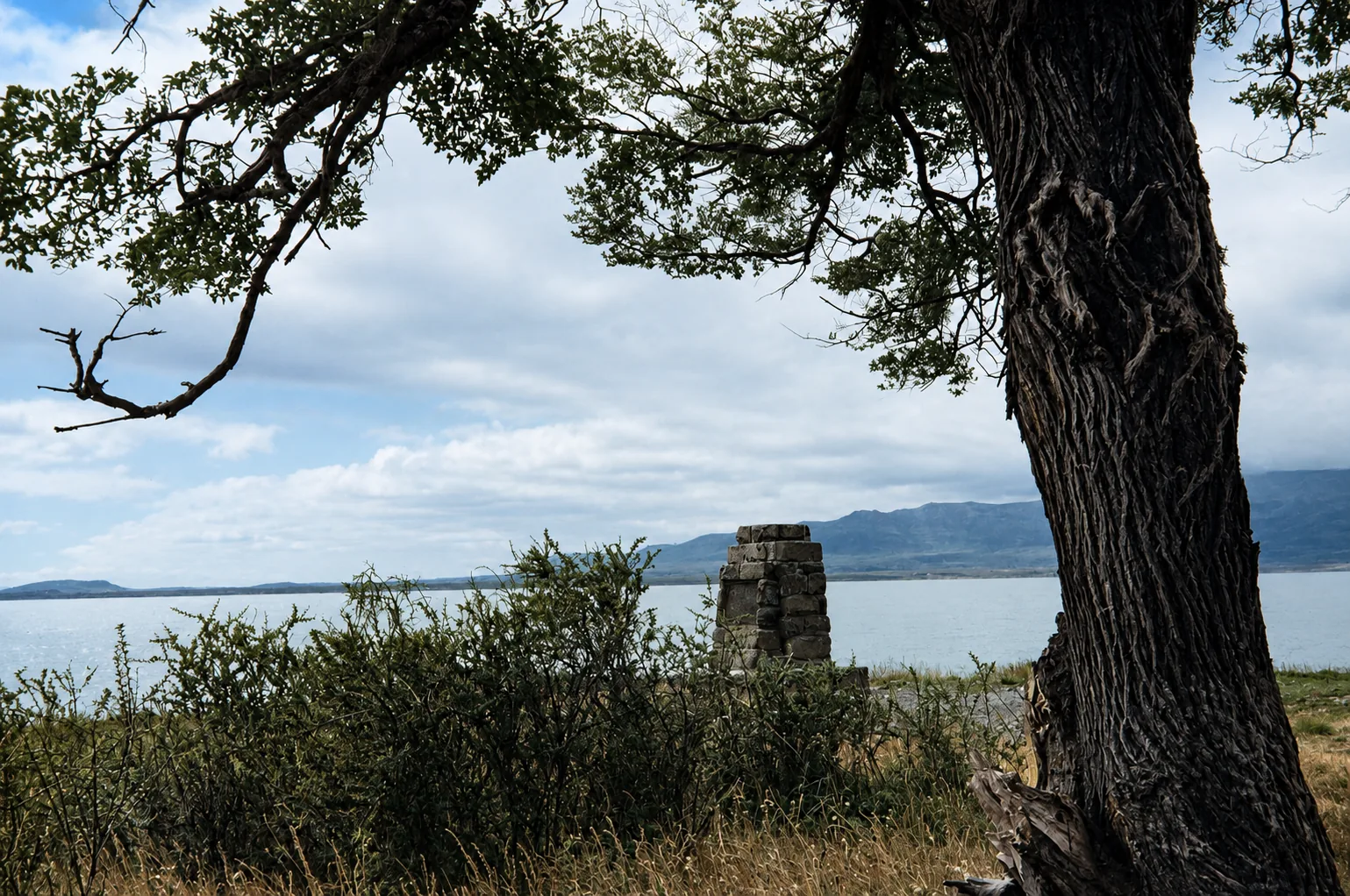
From the makeshift grave of 1931 to the inaugurated memorial four decades later. Photographs from the archive of the Schröppe family.
What The Films Are Today
The original film Silberkondor über Feuerland survived the Second World War in German archives. It has been in the public domain since 2001 — seventy years after Plüschow's death. Moorschmied Manufactory is currently digitising and restoring the material to 4K resolution. The ongoing pipeline work is documented on the page Plüschow's Film 1928.
Plüschow's three Patagonian voyages produced 1,500 metres of film, several hundred photographs and three books. They constituted the most extensive German research programme on Tierra del Fuego in the twentieth century. What endures from that today: the wood, the films, the remembering.