Chapter 4
Feuerland-Eiche
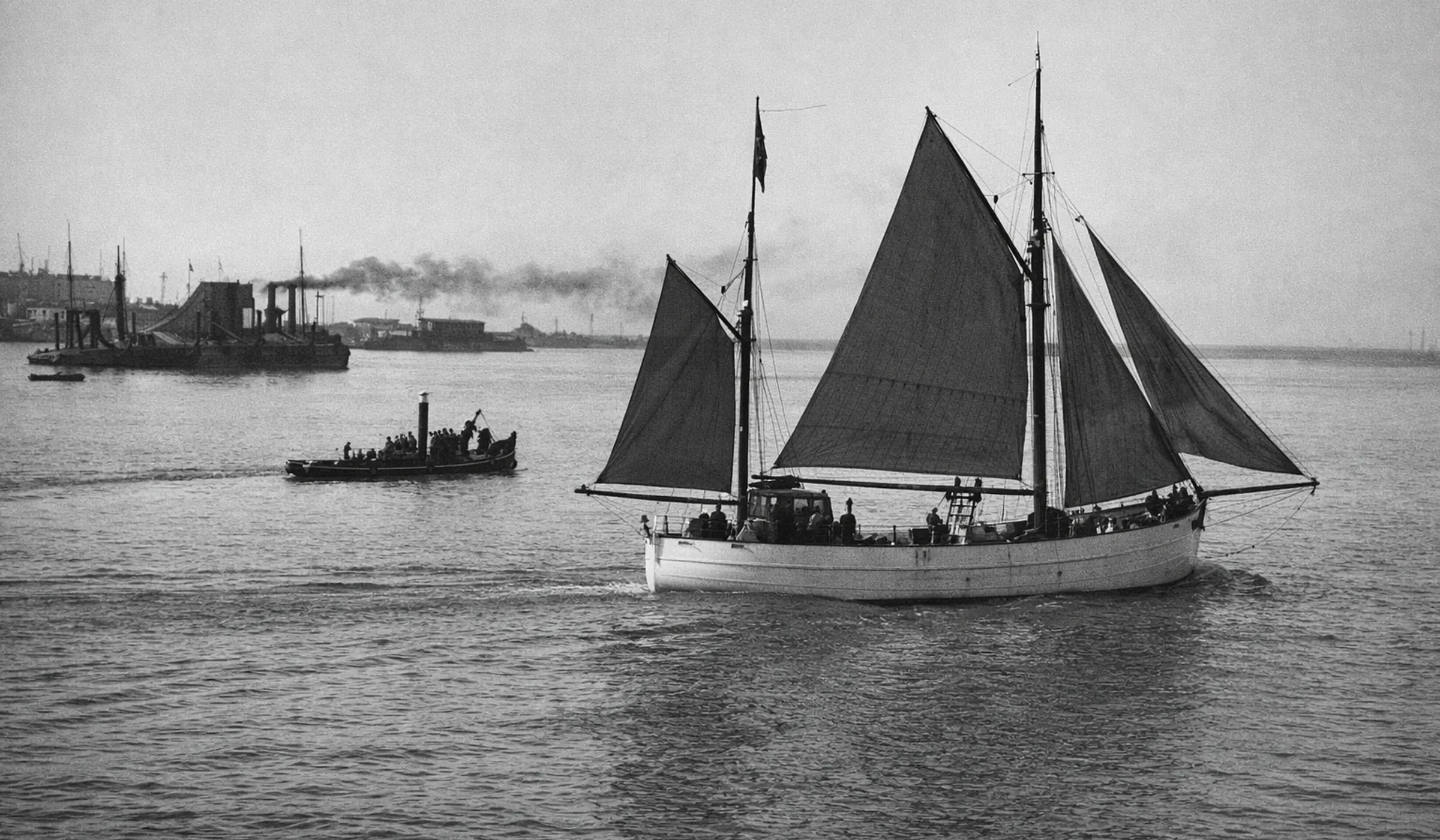
Oak wood that has survived Patagonian storms, Falkland Islands (Malvinas) shellfire, polar ice and summer sun.
The oak that now rests in the workshops of the Manufactory is not the timber that was worked at the shipyard in Büsum in the spring of 1927. It is what remained of it after 98 years on the water. Salt has made the wood denser. Storms have bent it. Sun has bleached it. Ice has touched it. What Moorschmied Manufactory makes from this material in its workshops is the continuation of a history of movement.
Quercus robur, 8 centimetres thick
The timber is English oak — Quercus robur, the classic shipbuilding oak of central Europe. Shipbuilding oak is typically felled at an age of between 80 and 150 years. When the planking of Feuerland was fitted in 1927, the timber itself was already a century old. Its total age today lies somewhere between 200 and 250 years.
The planking at the waterline — where the vessel was most frequently exposed to ice and drifting timber — measured eight centimetres in thickness. The frames were set at intervals of 55 centimetres. Both are overbuilt for a ketch of this size. Plüschow wanted a ship that would carry him beyond the storms of Tierra del Fuego. He got one that survived the Falklands War.
Patagonian storms, Falkland Islands (Malvinas) shellfire, polar waters, summer sun — and 19 years in restoration shipyards. What remains workable after all of that is not accidentally hard.
What 98 Years of Salt Water Do
Long exposure to salt water produces several distinct effects on oak wood:
Hardness
The wood absorbs salt; the salt crystallises within the wood fibres; the fibres become denser. An oak that has spent a century on the water has reached a hardness that is no longer comparable to freshly felled oak.
Colour
The wood darkens. In the Feuerland oak, the colour range extends from pale honey-brown — in sections that lay below deck — to deep blackish-brown in sections that were directly in the water.
Structure
The grain becomes more pronounced, because the softer early-wood components wear away faster than the harder late-wood portions. What remains is a relief-like grain that in cross-section appears almost like fur.
Scent
The oak tannins give off a faintly smoky, faintly tarry base note — amplified by the pitch pine element in the deck. Those familiar with vessels of this period will recognise the scent at once.
Processing in the Workshop Spaces
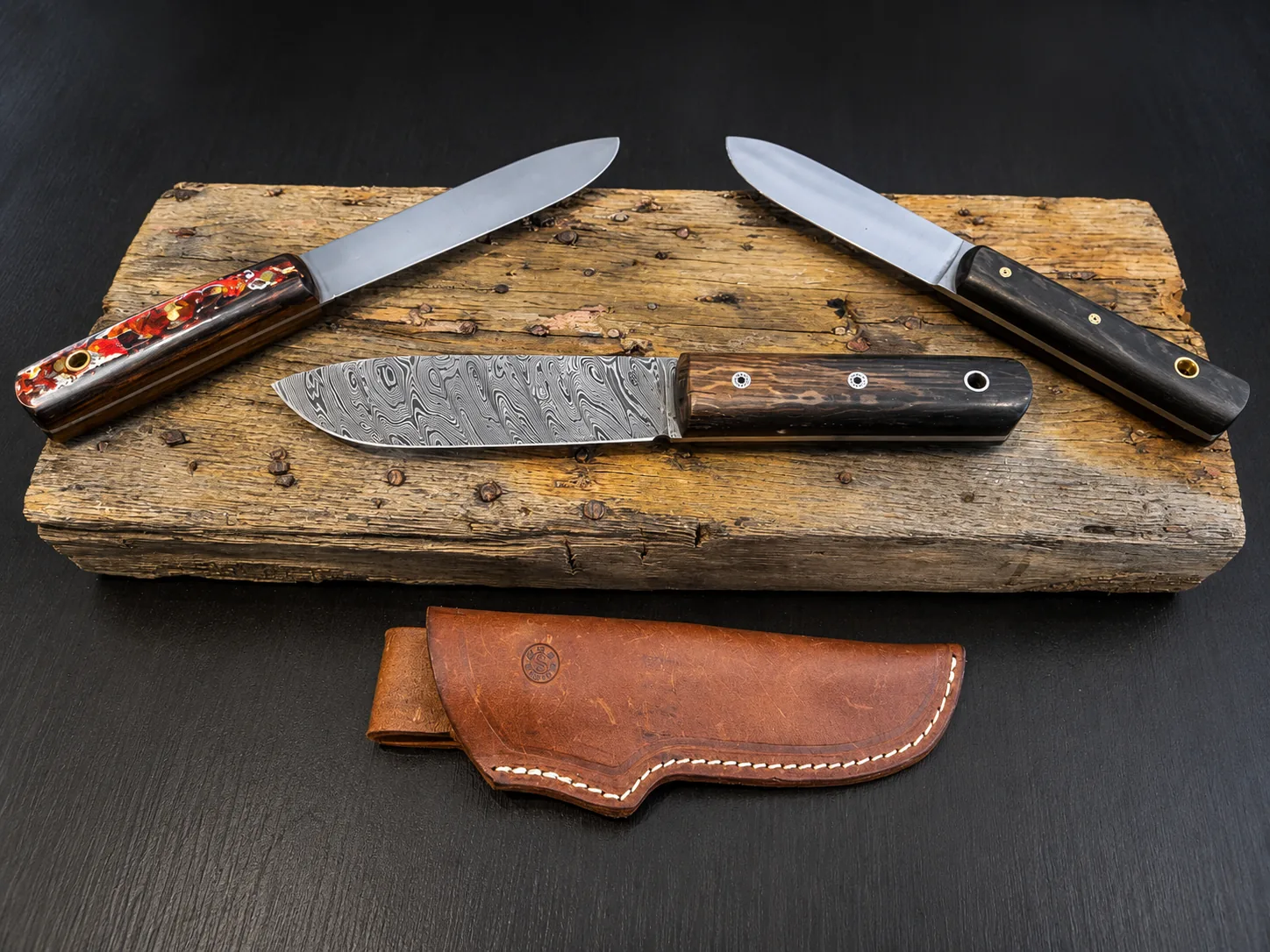
The Moorschmied Manufactory works the oak into knife handles and collector's items. The work is not straightforward: ship's timber after 98 years is not like fresh wood. Drilling must be pre‑cooled, saw cuts made more slowly, and adhesive applied in different proportions. The blades are produced in parallel at the forge — the oak handles in the woodworking spaces.
Before processing, each piece is numbered, photographed and recorded in the manufactory's internal inventory database.
Stabilisation of the wood: consolidation and preservation of residual colour
To make the surviving timber sections of the Feuerland lastingly usable for knife handles, they must not only be worked by hand but also secured at a material level. Of particular importance is the preservation of the paint traces still visible on the surface. These are not merely decorative marks; they are part of the ship's history: surface, use, ageing and provenance remain legible through them.
For this stabilisation, the manufactory draws on the Raffir process developed by the Danish company Raffir ApS. Raffir specialises in stabilised natural materials, including timbers, fossils and composite materials. With Raffir Wood, finely structured wood is treated in a high-pressure resin process. The material becomes harder, more resilient and better suited to further working; at the same time, the grain and grown structure emerge more distinctly.
For the manufactory's knife handles, this process is a natural choice: the historic timber is not to be transformed into a new, anonymous material, but rather secured in its substance and preserved in its visible history. The stabilisation thus serves not only technical durability, but also the respectful treatment of a documented piece of maritime history.
Provenance
Photographic provenance confirmation and documented provenance reference to the ship Feuerland (Q1409581 in Wikidata). The transfer of the timber from Museumswerft Flensburg to the Moorschmied Manufactory is documented. A photographic inventory, an inventory list and a measurements record are likewise part of the dossier.
The dossier is made available on request — for collectors prior to an acquisition, for press contacts prior to publication, for research enquiries. It is not publicly available for download, because the value of its authenticity is upheld through restraint, not through advertisement.
What the Oak Is Not
The Feuerland oak is not 'mythic substance'. It is concrete timber with a documented provenance history. To hold a handle made from this wood is to hold material from a ship built in Büsum in 1927 — no less, no more.
The Manufactory communicates in this tone deliberately and without embellishment. Pathos sits poorly with substance. What sets the Feuerland oak apart from ordinary oak hull planking two hundred years old is provenance and history — both verifiable, both documented.
The oak of the Feuerland is a finite stock. What the Manufactory makes from it is defined not by quantity, but by the care taken in working it and the rigour of the documentation.